Introduction
Last year, I went on a sabbatical.
For eight months, I unplugged — no tech podcasts, no webinars, no projects. I used AI the way I'd use Google: to translate menus, sort out travel logistics, do light research about whatever country I happened to be in. I simply stopped keeping up with how the tools were proliferating, evolving, dying. Eight months is a long time when the landscape is moving as fast as it is.
Upon my return, many of the AI products that had been in their early stages when I left had matured. Others had been absorbed or abandoned. And the conversation around AI had shifted from speculative to operational — companies were restructuring around it, agencies were selling it, and practitioners were quietly wondering where they fit.
I had the same question. Not with panic, but with genuine curiosity: was I being replaced? Was it my team that was being replaced? Or was it something more subtle — a rearrangement of value that hadn't fully revealed itself yet?
I decided to find out by running an experiment on something I had a practical use for: rebuilding my portfolio. The last time I'd really given it attention was over five years ago. It was time to see what I could make possible with a vision and Claude Code.
What I found is this: AI strips away the parts of the job that were never the hard part and exposes the parts that require real expertise. The value of a senior practitioner isn't diminished by AI. It's clarified.
The Experiment
I ran three approaches, each with a different division of responsibility between me and Claude Code. Think of them as three archetypes for how a person might work with AI — and the outcome of each reveals something about what AI actually needs from the human on the other end.
AI as full team
Investigate what Claude Code can do when given full responsibility for strategy, design, and development.
Human role: client
AI as collaborator
Use Claude to co-develop a brief, then hand it off to Claude Code to interpret and build.
Human role: strategist
AI as extension
Assume the creative and strategic lead; use Claude Code to execute and extend the system.
Human role: creative director
01 / AI as Full Team
I gave Claude Code the site's context: who I was, my positioning, the purpose of the site, who it was intended for, and the feeling I wanted the design to convey. Then I stepped back.
Create a Director-level UX strategy and design portfolio that is geared toward hiring managers, recruiters, and practice leads. It should feel mature yet fresh — editorial, magazine-like, and a little unconventional with an edgy, architectural style. Use muted colors or off-white and off-black. Green is a good base color. Feature case studies, services offered, and thought leadership.
I was giving it responsibility for every role on a creative and development team: the experience strategist, the creative director, the developer. I was functioning as a client — specifically, a client without insider knowledge of the design process. I answered only the questions Claude Code thought to ask.
A human team would have probed further. They'd have asked about competitive context, about visual references, about what "minimal and architectural" actually meant to me. Claude Code didn't. Without prompting, it accepted what I gave it and moved forward.
What it delivered met the brief. It had a logical architecture. A visitor could find what they needed. But it looked like a Squarespace template.
It was, in a word, bland. It lacked a soul.

With AI, the quality of your output is directly correlated to the quality of your input. I'd given it sparse information and gotten a generic result. That's predictable. But the more interesting takeaway wasn't about the output — it was about the input. Claude Code didn't know what it didn't know. It didn't ask the questions that would have elevated the work, because it had no framework for recognizing what was missing. That's the gap between a tool that can execute and a practitioner who knows what to ask.
02 / AI as Collaborator
In the second approach, I engaged non-coding Claude first to co-develop a creative brief that spanned UX strategy, design direction, and a development plan before handing it off to Claude Code.
I prompted Claude to act as a creative strategist: to identify gaps in the information I was giving it, ask me clarifying questions, and push for the kind of specificity it would need to make informed design decisions. It performed this role well. At one point, it unpacked the descriptive language I'd used and asked me to select which digital brands best exemplified what I meant. That's an exercise remarkably close to what I'd run with a client myself.
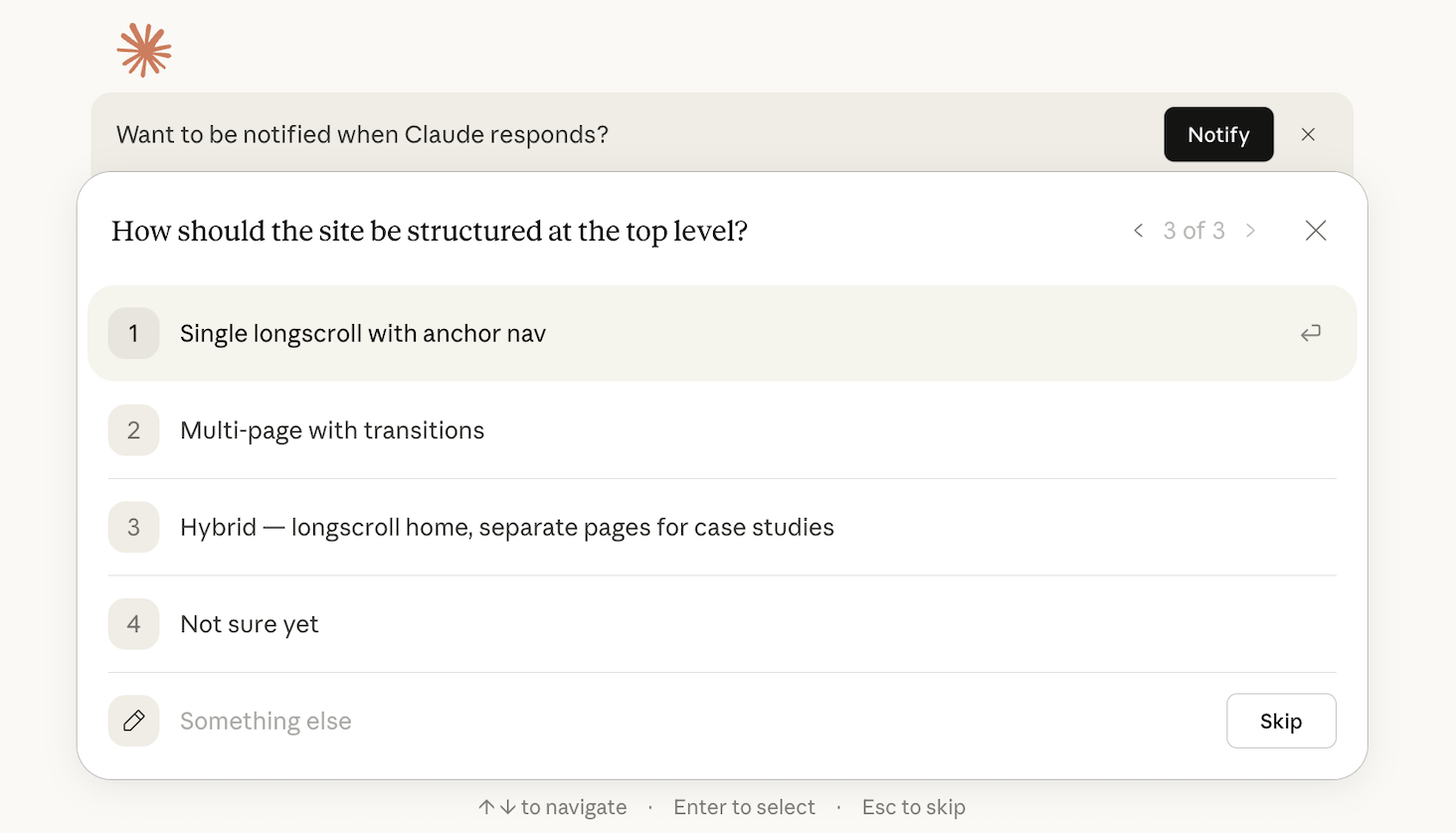
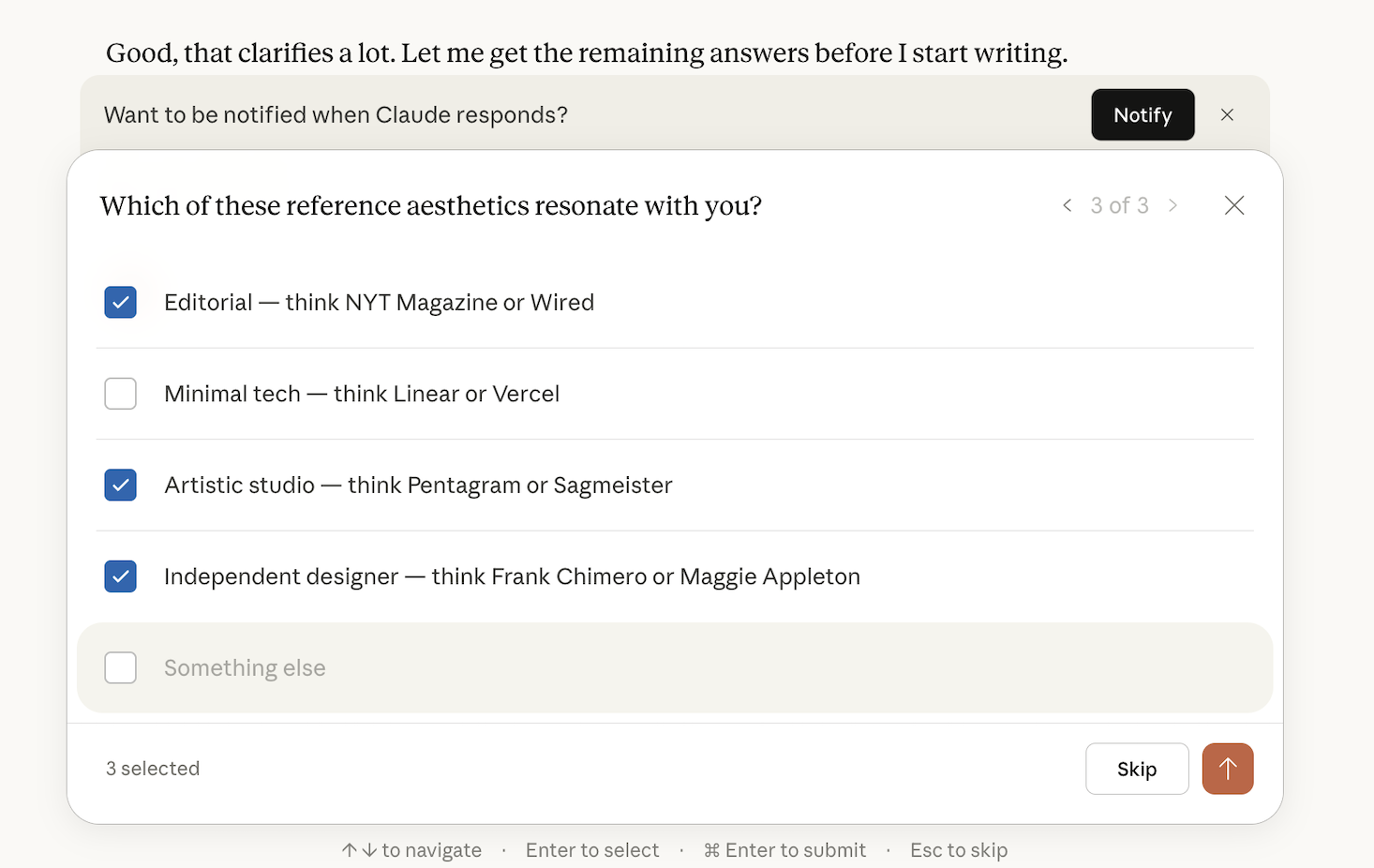
When I moved to Claude Code, I activated the Frontend Design skill and prompted it to ask clarifying questions and create a plan before building anything. I reviewed the brief and an export of the UX copy we'd co-written — organized as a spreadsheet, complete with placeholders where I still needed to write key copy.
The process was sound. Claude had followed a methodology that would hold up in a professional context. It asked the right kinds of questions, structured the brief logically, produced organized deliverables.
And then Claude Code rendered the home page, and I could see immediately that the brief hadn't been enough.
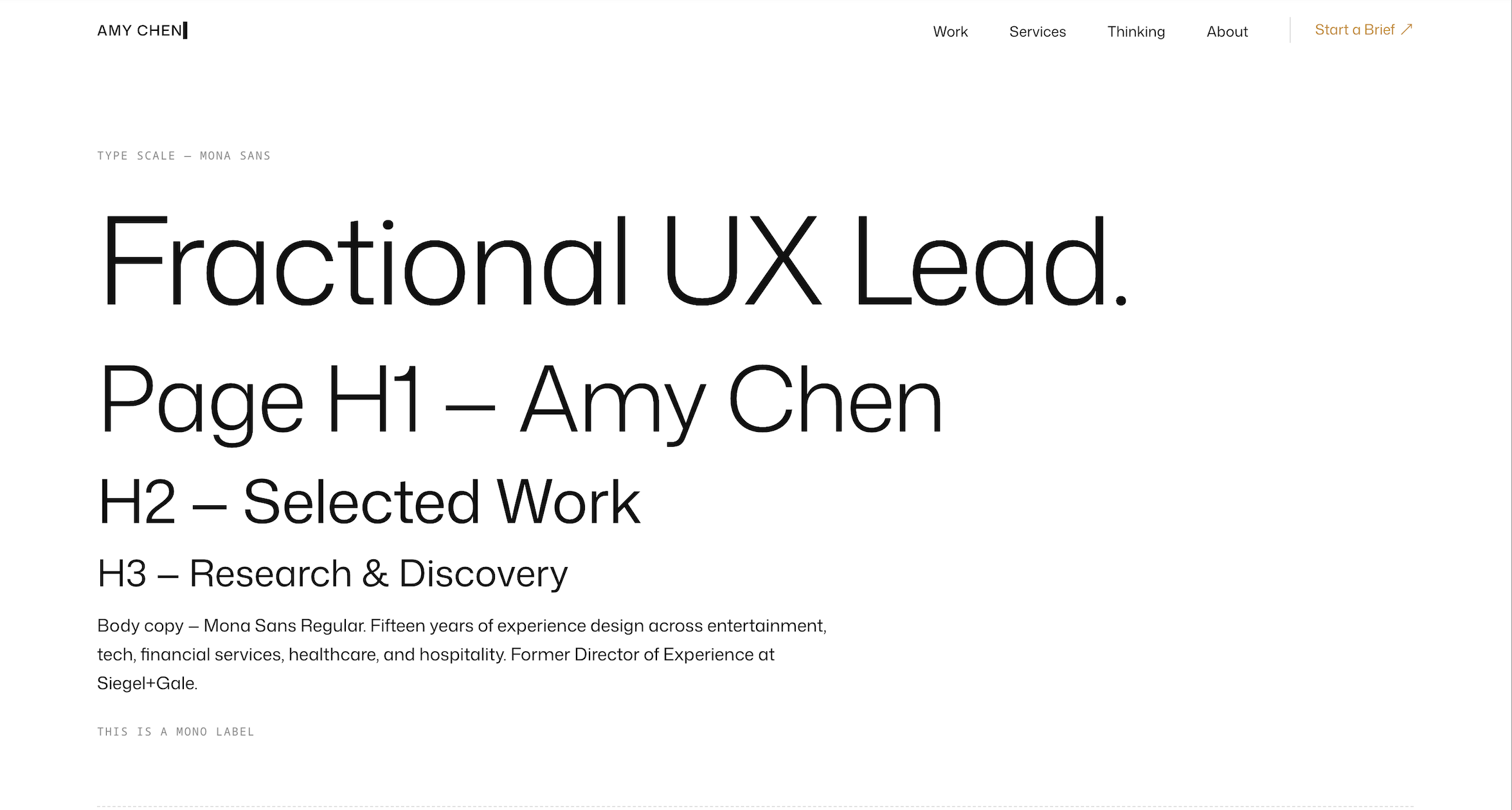
There were elements that were right. But it wasn't my vision. The design had been carefully and specifically described in words but there was still too much room for interpretation. I could have spent more time prompting my way toward what I had in mind, but I'd hit the boundary of what language alone can communicate about a visual idea.
This is the part I think matters most for anyone evaluating what AI can do in a creative context: Claude performed the process well. The brief was structured, the questions were relevant, the deliverables were organized. But process alone didn't produce the outcome. A good process is a vehicle. The destination still depends on who's driving.
If you're looking to get a functional site built and you're open to revising as you go, this approach will take you far. But for practitioners whose work depends on a specific vision where precision and intention are the point, the gap between a well-written brief and a realized design is where expertise lives. And right now, that gap can't be closed with words alone.
03 / AI as Extension
The third approach was the one that reflected how I actually work: I assumed the roles of creative director, strategist, and designer, and used Claude Code as a production tool to build and extend the system I'd defined.
Since I had a specific vision, it was faster to mock up the home page in Figma than to prompt my way toward it. I skipped the prototyping step since I was moving straight to code, and handed the mockup to Claude Code with descriptions of the page interactions. From there, it was often faster to prompt Claude to adjust an interaction than to do it in a design tool.
To build the rest of the site, I mocked up a few more elements where I needed to work through the design thinking myself. After the home page was developed, Claude Code was already well set up to extend the system across the remaining pages.
And it did… mostly well. It picked up patterns and applied them consistently. But this is where my experience became the difference between a competent site and the site I actually wanted.
Claude Code couldn't judge the relative scale of images. In my case studies, it would render a large mobile screen alongside a much smaller flowchart or persona, as though they were equivalent. It didn't know to normalize carousel images to the same height. These are details that seem small in isolation, but they're the kind of thing that separates polished work from work that just clears the bar.
More subtly, some of the patterns Claude Code selected were functional but predictable. On the About page, for instance, there was room to push the design further — to make a bolder choice that would have been consistent with the visual system I'd established — but Claude defaulted to the safer, more expected option. It followed the rules of the system. It didn't know when to break them.
This is the shift I didn't fully anticipate. Working with AI at this level, the cognitive demand isn't in the making. It's in the evaluating. The code gets written quickly. The layouts appear. And the work becomes: is this right? Is this good enough? Is this what I intended, or is it just close enough to pass? That kind of judgment only comes from experience — from having spent years seeing what works, what falls flat, and why.
What I Learned
-
Claude can't see what we see.
It interprets its own code and understands intent, but it can't evaluate whether the rendered output actually works. A human still needs to be on the other end, deciding if what it made is right.
-
Claude doesn't always make the right call.
Without constraints, it'll make questionable decisions: a gallery treatment for images that should have been displayed linearly, inconsistent scaling, safe choices where the design called for boldness. These aren't errors in logic. They're gaps in judgment.
-
Claude can create, but it can't be creative.
With its Frontend Design skill activated, it generates decent work. But "decent" is the ceiling when there's no one in the room who knows what "exceptional" looks like for this specific problem. AI is excellent at replicating and extending a system once one exists. It is not yet capable of the generative, vision-setting work that gives a system its character in the first place.
-
Process is not magic.
Claude followed a sound methodology in Approach 2, the kind of structured process that would hold up in a professional review. But a good process executed without vision produces competent, generic work. The insight isn't that process doesn't matter. It's that process is a vehicle, not a destination.
So What Does This Mean?
Would I have been able to build this portfolio without AI? Yes, but it would have required me to fully prototype in Figma and hire a developer. My first working version took roughly 10 hours of active work, including the brief-building. Writing the copy, refining the design, and developing case study visuals took longer, but would have taken even longer still without AI.
Would Claude Code have built this portfolio without me? No. It could have produced a portfolio. It would have been functional, organized, and clean. But it would not have had the specificity, the personality, or the intentional imperfections that make the work mine.
AI is great at following rules and conventions. Humans are great at messing things up in beautiful ways.
That's a line worth sitting with, because I think it gets at something the industry is still working out. If the goal of any product, experience, or brand is purely functional — solve the problem, ship the thing, clear the bar — then AI will get us there faster than ever, and it will keep getting better at it. But if we want to move beyond the functional and begin to make things that inspire, surprise, or advocate for something better, then a human's taste, judgment, and willingness to deviate from the pattern is what curates the way forward.
The question I keep returning to isn't whether AI is replacing practitioners. It's which practitioners it reveals as essential.
For someone early in their career, AI is a powerful accelerator — but only if there's enough foundational experience to evaluate what it produces. For a senior practitioner, AI clarifies exactly where your expertise lives: in the vision-setting, the quality judgment, the ability to spot what's wrong before anyone else notices, and the willingness to push past "good enough." Those are the skills that no amount of prompting can replace, because they come from years of doing the work, seeing the outcomes, and learning what to look for.
The portfolio you see today was built by me and Claude Code together. The strategy, design, and creative direction are mine. The system extension, the code, and a good deal of the production work are Claude's. That division of labor isn't a concession. It's a model for what's coming — and it requires both sides to be very good at their respective jobs.